
In the vast, shimmering landscape of Gujarat’s Great Rann of Kutch, the village of Dhordo has emerged as a powerful example of how heritage, community resilience and responsible tourism can together create a destination of global significance. In 2023, Dhordo received the distinguished recognition of Best Tourism Village from the United Nations World Tourism Organization—an honour reserved for rural destinations that demonstrate excellence in cultural conservation, sustainability and community participation.
The impact of this global recognition has been both immediate and measurable. Tourist arrivals to Dhordo where globally recognised Rann Utsav being celebrated, witnessed a sharp surge, rising from 2,07,781 visitors in 2022 to 7,28,615 in 2023, reflecting a remarkable 250.66% year-on-year growth. This momentum continued with 9,50,759 visitors in 2024 and 9,90,593 in 2025, with growth rates stabilising at 30.49% and 4.19% respectively—signalling a transition from rapid expansion to sustained and mature tourism growth.
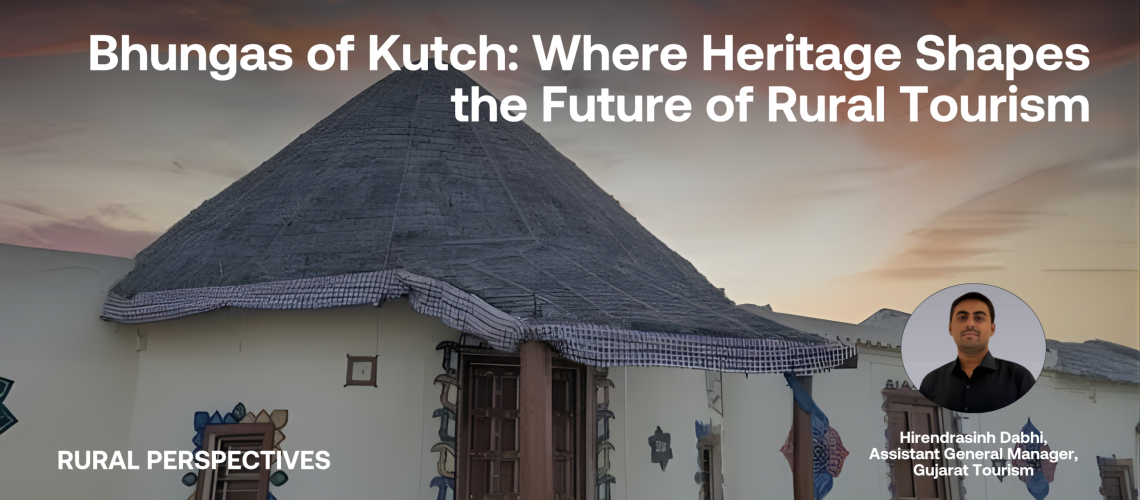
Central to Dhordo’s identity is the traditional Bhunga, the indigenous dwelling of the Kutch region, which stands as one of Gujarat’s most enduring expressions of cultural intelligence and climate-responsive architecture. Recognising its value beyond mere construction, the Gujarat Tourism Department has brought Bhunga architecture to the forefront of its vision for Kutch—positioning it as an immersive cultural experience that reflects resilience, heritage and the collective wisdom of local communities.
These distinctive circular mud structures are far more than homes; they are thoughtfully engineered responses to Kutch’s extreme climate and seismic conditions, while simultaneously showcasing the region’s vibrant cultural ethos. Their design, refined over generations, represents a seamless blend of practicality, sustainability, and tradition. The spatial planning of Bhungas is guided by age-old principles that prioritise environmental harmony and efficiency. Their circular layout encourages natural airflow and optimal daylight, while offering effective protection against intense heat and strong desert winds. Roof construction follows a carefully evolved traditional process—wooden beams form the base framework, anchored by a central kingpost, with rafters arranged to shape the roof and finished using locally available materials such as straw or thatch. The result is a durable, weather-resistant shelter ideally suited to desert conditions.
Among the most captivating elements of Bhunga architecture is Lippan Kaam, the region’s iconic mud-and-mirror art. Crafted using clay and reflective elements, this intricate wall decoration narrates stories inspired by nature, spirituality, and community life—serving as a living canvas of Kutch’s cultural heritage. Windows, often framed with finely carved wood, are designed to enhance ventilation, preserve privacy, and shield interiors from harsh environmental conditions, while maintaining visual harmony with the surrounding landscape. Despite their modest appearance, Bhungas demonstrate exceptional earthquake resistance. Their low height and circular form reduce structural stress during seismic activity, while the flexibility of mud walls and thatched roofs absorbs and disperses vibrations—significantly enhancing safety.
The growing popularity of Bhunga-based tourism is also reflected in rising community participation. The number of registered homestays and Bhunga-style accommodation units increased from 52 in 2022 to 63 in 2025, with consistent year-on-year growth—7.69% in 2023, 3.57% in 2024, and 8.62% in 2025—underscoring the strengthening role of local communities as stakeholders in tourism development.
With Dhordo already attracting international visitors as the venue of the globally celebrated Rann Utsav festival, the economic impact of this cultural ecosystem continues to deepen. Estimated income generated from the festival increased from ₹113.82 crore in 2023 to ₹161.34 crore in 2024, registering a robust 41.75% year-on-year growth—a clear indicator of tourism translating into tangible economic benefits for the region.
As Gujarat expands its tourism vision beyond seasonal travel, Bhunga-based tourism presents an opportunity to foster year-round, community-led experiences rooted in architecture, craft, ecology, and living traditions. By embracing Bhungas as the foundation of sustainable tourism development, Gujarat is championing a model that is environmentally responsible, community-owned and deeply connected to the unique landscape of Kutch—strengthening local livelihoods while safeguarding cultural heritage for generations to come.
About the Author:
Hirendrasinh Dabhi is an Assistant General Manager (Marketing & Promotions) at Gujarat Tourism, where he plays a key role in promoting Gujarat’s tourism destinations through strategic branding and integrated promotional initiatives. He coordinates diverse promotional operations, collaborating with multiple stakeholders, communities and other govt. departments to enhance the visibility and appeal of the state’s tourism offerings.
A significant focus of his work is the promotion of Dhordo village in Kutch as a flagship model of sustainable, cultural and rural tourism. Through Gujarat Tourism’s initiatives, he actively works to strengthen community engagement, build effective networks, and ensure that tourism development supports local livelihoods, preserves cultural heritage and empowers rural communities through responsible and sustainable tourism practices.
(Disclaimer: The views expressed in this article are solely those of the contributor and do not necessarily reflect the opinions or views of UN Tourism or any affiliated organizations.)