
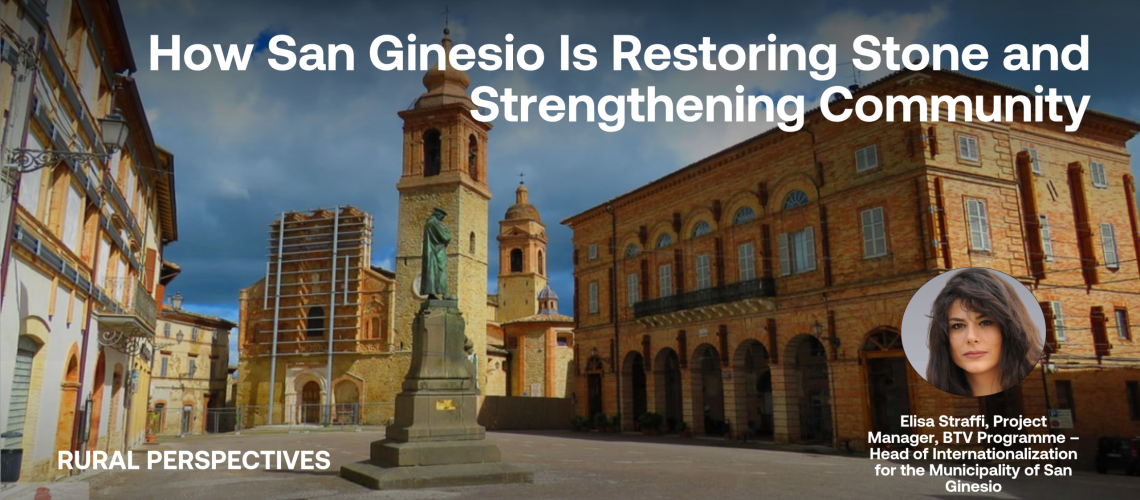
Perched along a ridge overlooking the Sibillini Mountains, San Ginesio has for centuries embodied a unique dialogue between architecture and community life. Here, ancient walls are not merely defensive structures, but repositories of shared memory. Its piazzas are not simply public spaces, but places of encounter, celebration, and collective identity.
That is why, when the devastating earthquakes of 2016 struck central Italy, the damage went far beyond stone and mortar.
The fractures were both structural and deeply social. Losing access to landmarks such as the Collegiata di Santa Maria Assunta and the historic Teatro Leopardi meant losing, even temporarily, the reference points of everyday life. In a village where nearly every building carries a civic, cultural, or spiritual purpose, the closure of these spaces reshaped routines, traditions, and relationships. And yet, from this disruption emerged a renewed understanding of heritage, not only as something to preserve, but as something capable of driving regeneration.
Protected under national landscape conservation law, the historic centre of San Ginesio includes nearly forty listed monumental buildings, forming an extraordinary medieval fabric layered over centuries. Public investment dedicated to monumental restoration alone now exceeds €15 million, reflecting a belief that conservation is not an investment in the past, but in the future.
Rebuilding as it was, only stronger
Reconstruction in San Ginesio raised a crucial question: how do you guarantee safety without compromising the aesthetic and emotional soul of a historic village? The answer has been what local experts describe as “invisible upgrading”—strengthening buildings from within while preserving the historic character that defines the village. The overall reconstruction plan, covering both public and private interventions, now exceeds €150 million under Italy’s national post-earthquake recovery framework. Today, more than 45 percent of construction sites within the medieval core are either completed or actively underway. But beyond statistics, these figures tell a more human story: shops reopening, lights returning to historic windows, and familiar voices once again filling the piazzas.
Among the most symbolic projects are twelve major monumental restorations. Alongside the Collegiata and the Teatro Leopardi, particular attention is being given to the Ospedaletto dei Pellegrini, an ancient hospice that once welcomed travellers along devotional routes. Restoring it means reconnecting the village with a centuries-old tradition of hospitality.
Recovering heritage beyond the walls
Reconstruction here has never stopped at façades. In collaboration with heritage authorities, San Ginesio has also embarked on a profound process of cultural recovery. Damaged altarpieces, sixteenth-century wooden sculptures, and sacred artworks rescued from churches across the village are being carefully restored and returned to their original homes. This is not simply about preserving objects. It is about restoring the village’s spiritual geography.
Particularly symbolic is the restoration of the historic stage curtain of the Teatro Leopardi. More than a theatrical element, it has long represented a threshold between memory and storytelling, between individual lives and collective identity. Restoring it meant restoring part of the village’s cultural soul.
The science behind resilience
Behind the quiet beauty of San Ginesio’s stone façades lies a sophisticated technological effort. Advanced restoration techniques, including low-pressure hydraulic mortar injections, structural ring reinforcements, fibre-reinforced systems, and continuous structural monitoring, are helping ensure that centuries-old buildings can meet modern safety standards without losing their authenticity.
Biocompatible materials are also being used to guarantee compatibility with original masonry, ensuring that restoration today does not become deterioration tomorrow. Much of this work remains invisible to visitors, but it is precisely this silent innovation that makes long-term resilience possible.
When recognition became momentum
A new chapter for San Ginesio began when it joined the Best Tourism Villages network by UN Tourism. For the village, the recognition arrived at a deeply meaningful moment.
It brought international visibility to a community already demonstrating extraordinary resilience. It introduced San Ginesio’s story to global audiences, creating new opportunities for cultural exchange, sustainable tourism, and collaboration with rural communities across the world. More importantly, it strengthened local confidence. What was once seen as a village recovering from disaster began to be recognised as a living model of heritage-led regeneration, community resilience, and sustainable rural development.
In San Ginesio, reconstruction has never been solely about buildings. Every construction site has represented a signal of continuity. Every reopened church has reactivated rituals, festivals, and family memories. Every restored public space has invited residents and visitors to reconnect with the village and with one another. Today, San Ginesio stands as a powerful reminder that heritage is not only inherited, it can also shape the future. And here, perhaps more than anywhere, every restored stone brings back not just a building, but a piece of the community.
About the Author:
Elisa Straffi serves as Relationship Management and Special Projects for the Municipality of San Ginesio within the UN Tourism Best Tourism Villages Programme. She coordinates relations with local partners, stakeholders, and communities, supporting the development of innovative projects and strategic initiatives that enhance sustainable tourism, territorial attractiveness, and the growth of local businesses, in close collaboration with the Mayor. With experience in project management and place promotion, she works to strengthen community engagement, foster effective networks, and contribute to positioning San Ginesio as a model of high-quality cultural and rural tourism.
(Disclaimer: The views expressed in this article are solely those of the contributor and do not necessarily reflect the opinions or views of UN Tourism or any affiliated organizations.)