
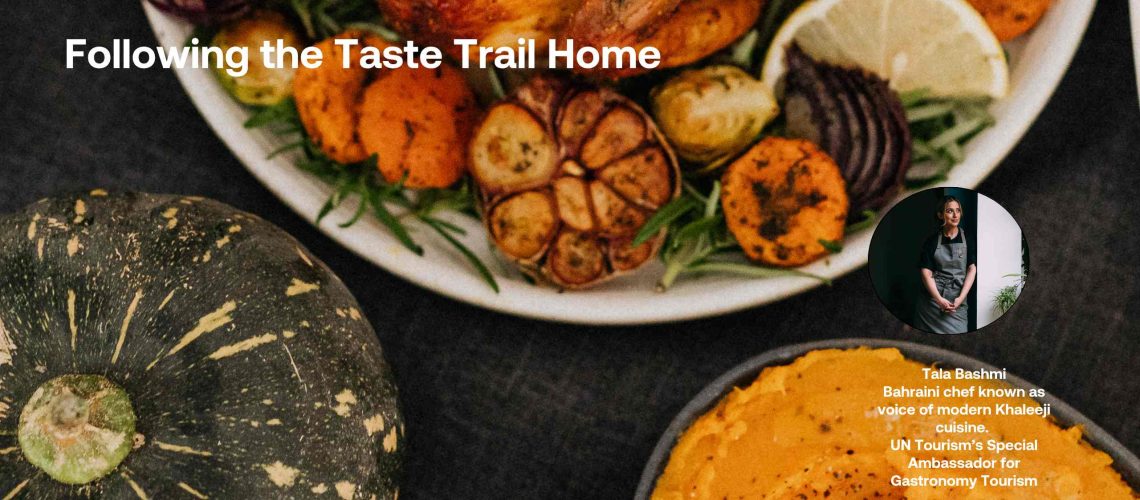
Following the Taste Trail Home
There is a particular hour on a Friday morning when the fish market in Manama is at its loudest – ice being shoveled, crates dragged across wet floor, someone shouting the price of a catch that came in an hour ago. I have been going to markets like this one since I was six years old, holding my father’s hand and trying to keep up. I didn’t know it then, but those mornings were teaching me the only thing I still believe matters in cooking: that food cannot be separated from the place, and the people, who made it possible.
That belief is why, when UN Tourism asked me to write about gastronomy tourism, I didn’t want to write about restaurants at all. I wanted to write about markets, and about the quiet, unglamorous work of the people who keep a region’s food culture alive long after the rest of the world stopped paying attention to it.
The Market Was My First Classroom
My father was a writer, not a cook, but he understood that you cannot tell the story of a place without tasting it first. He used to bring me ingredients other children had never heard of and dare me to figure out what to do with them. He’d introduce me to a fishmonger, a spice seller, a farmer with a small plot of vegetables, and let them do the explaining. I learned the names of things- and the reasons behind them — from the people who grew, caught, and sold them, not from a book.
My father is Bahraini, and it was through him that I first learned the rhythm of this island’s kitchens. My mother is Saudi and growing up moving between her side of the family and his gave me an early, almost unconscious sense of how wide Khaleeji cuisine really is – how a spice blend or a way of cooking rice can shift from one coastline of the Gulf to the next, related but never identical. I didn’t have the language for it as a child, but I was already learning that “Gulf food” was never one cuisine. It was several, in conversation with each other.
Years later, when I started cooking professionally, I went back to that same fish market, this time as a chef hunting for ingredients for my own menu — a place I still visit and always take visitors when they come to Bahrain. There, a particular fisherman, an older Bahraini man, has spent decades teaching me about fish I’d never have learned about otherwise, and about the dishes built around them — dishes you won’t find written down anywhere, only passed mouth to mouth across a market stall. That, to me, is the real archive of a country’s cuisine. Not a cookbook. A conversation.
What We Almost Lost
Some of the dishes I care most about reviving were never meant to be elegant. They were solutions – ways to stretch one fish across a family of ten, or to use every part of an animal because nothing could go to waste. One dish I only know because that same fisherman described it to me in detail one morning, and another my father remembered from his own childhood, had nearly disappeared from restaurant tables entirely. I’ve spent the better part of a decade trying to bring dishes like these back into view, not as nostalgia, but because they hold real information about how people adapted, survived, and found joy with very little.
This is the part of gastronomy tourism I think deserves more attention: it isn’t only about discovering new flavours, it’s about discovering who still remembers the old ones. In almost every community, in almost every country, there is someone – usually older, usually overlooked – holding an entire culinary history in their hands with no one asking them to share it. When one of my own dishes was later included in a United Nations culinary guide, what moved me wasn’t the recognition. It was knowing that a recipe born out of necessity in someone’s home kitchen had found its way onto a global stage.
Why Gastronomy Tourism Changes Who Benefits
Since taking on the role of UN Tourism Special Ambassador for Gastronomy Tourism, I’ve come to think about this even more directly: the best food destinations in the world are, in a sense, kitchens without walls. A traveller who sits down to a meal cooked by a local family, or buys vegetables from a roadside stall instead of a supermarket, isn’t just having a nicer holiday. They are putting money directly into the hands of the people responsible for keeping a region’s identity intact – the farmer, the fisher, the home cook who never went to culinary school but could outcook most chefs I know.
This is why I believe gastronomy tourism, done well, is one of the most powerful and most overlooked forms of travel we have. It protects culture instead of flattening it for an audience. It rewards authenticity instead of asking communities to perform a version of themselves. And it gives small, easily overlooked communities – the kind that will never make a guidebook for their architecture alone – a reason for the world to find them, learn from them, and return.
An Invitation to Travelers
If you take one thing from this, let it be this: when you travel, find the market before you find the monument. Ask the woman selling bread what her mother used to make. Sit at the smallest table, not the busiest one. The best meal you’ll have probably won’t be on a menu – it will be the result of someone deciding, generously, to let you taste where they’re from.
That is what a taste trail really is. Not a list of dishes to check off, but a path that leads you, one plate at a time, into the life of a place. I hope more travellers choose to walk it.
About the Author
Tala Bashmi is a Bahraini chef known as the voice of modern Khaleeji cuisine. She was Chef Patron of Fusions by Tala in Manama from 2020 to 2024. In 2022, she became the inaugural Middle East & North Africa Best Female Chef at The World’s 50 Best Restaurants – MENA, and in 2025 won the programme’s Estrella Damm N.A. Chefs’ Choice Award, its only peer-voted accolade. She also holds the Rising Star Award (2023) and Three Knives (2024) from The Best Chef Awards, voted on by a global panel of culinary professionals. She serves as