
For many rural villages, remoteness is often seen as a disadvantage—a reason why young people leave and why economic opportunities seem scarce. But what if this very distance from city lights and noise could be transformed into a unique, sought-after treasure? As the founder of Visit Dark Skies, I have witnessed how villages can turn their greatest “drawback” into an unforgettable experience for urban dwellers: the natural night sky, tranquil and ablaze with stars.
In cities, light pollution has all but erased the stars. Millions of children grow up never seeing the Milky Way, let alone experiencing the awe of a truly dark night. For urbanites, the night is rarely silent or truly dark. The constant hum of traffic, the glow of streetlights, and the pressure of schedules create a sense of disconnection—from nature, from themselves, and from the cosmos.
This is where rural villages shine. Their darkness and quiet are not shortcomings, but rare gifts. When visitors arrive, they are greeted by a sky untouched by artificial light, where thousands of stars—planets, meteors, and even the faint glow of distant galaxies—become visible. The silence is profound, broken only by the sounds of nature. For many, this is a transformative experience: grounding, humbling, and deeply restorative.
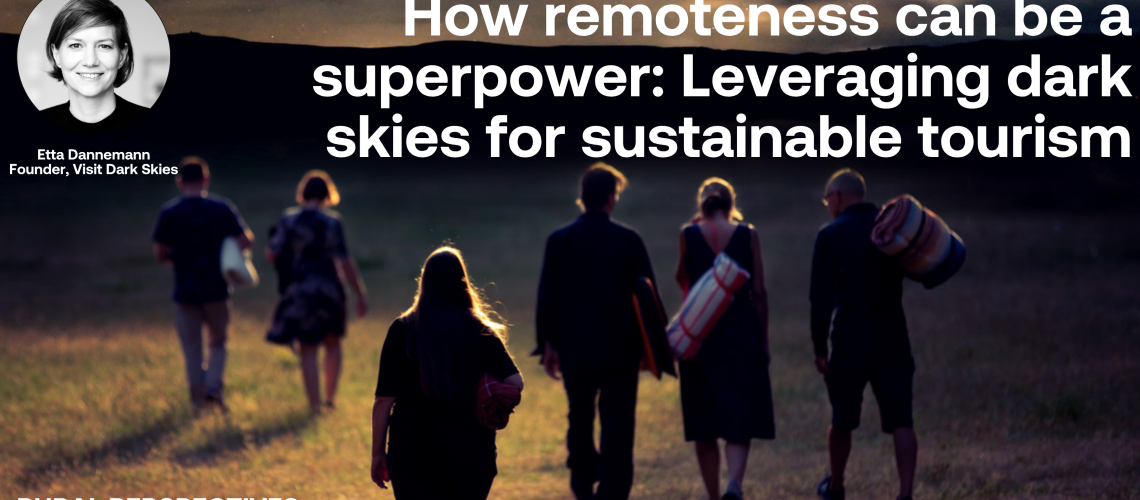
At Visit Dark Skies, we have pioneered guided starbathing and cloud gazing experiences to help guests reconnect with the sky and themselves. These immersive moments of mindfulness and wonder are not just about astronomy; they are about rediscovering a sense of place in the universe. Our guests often describe lying under the stars as “soulful” and “healing.” The vastness above puts daily worries into perspective, offering a sense of peace and belonging that is hard to find in urban life.
For villages, embracing their dark skies is also a path to sustainable tourism. Unlike mass tourism, which can strain local resources and disrupt communities, dark sky tourism attracts visitors who value nature, tranquility, and authenticity. These guests are often happy to support local businesses – staying in family -run guesthouses, dining on regional cuisine, and participating in community-led activities. The economic benefits are real, but so are the cultural ones: villagers can share their stories, traditions, and connection to the land, fostering meaningful exchanges between locals and visitors.
Moreover, by promoting the value of darkness, villages become stewards of the night. They help raise awareness about the importance of protecting natural darkness—not just for stargazing, but for wildlife, human health, and cultural heritage. In a world that is rapidly losing its night, these communities become beacons of hope and inspiration.
In conclusion, the remoteness of rural villages is not a liability, but a superpower. By inviting city dwellers to experience the natural night sky, villages offer something cities cannot: a chance to pause, look up, and remember our place in the universe. In doing so, they create memories that last a lifetime – and help ensure that the wonder of the night sky endures for generations to come.
About the Author:
Etta Dannemann is the founder of Visit Dark Skies and helps hosts in remote regions worldwide leverage the sky as a unique guest experience. She develops self-guided stargazing and cloud gazing experiences that enable tourism providers to offer memorable encounters with the night sky. Her work supports sustainable tourism and creates new value for hosts far from urban centers
(Disclaimer: The views expressed in this article are solely those of the contributor and do not necessarily reflect the opinions or views of UN Tourism or any affiliated organizations.)